Roof Options Bg

Commercial TPO Roofing in South Jersey

When you’re looking for a commercial roof replacement or installation, you have plenty of options, ranging from single-ply membranes to builtup bitumen systems. Out of the contenders for your flat or low-slope roof, you may have considered Thermoplastic polyolefin (TPO) roofing. It’s a cost-effective, energy-efficient material that the team at RGB Construction has plenty of experience installing.

We’re proud to carry GAF TPO, one of the highest rated on the market. Here’s everything you need to know about TPO roofing, as well as why you should choose RGB Construction as your commercial roofer in South Jersey.

White Tpo Roofing That Has Been Freshly Installed.

What is TPO Roofing?

Thermoplastic polyolefin (TPO) roofing is a type of flat roofing system for both commercial and residential buildings. TPO is a single-ply waterproofing membrane that can be heat-welded into place (hence the “thermoplastic”). The membrane also contains a fire-retardant, colorant, titanium dioxide (for heat absorption), and other additives from the manufacturer.

TPO comes in three standard thicknesses: 45-mil, 60-mil, and 80-mil, with “mil” being 1/1000 of an inch. Most commercial buildings will have 60-mil or 80-mil applied, since 45-mil is reserved for lower budgets.

You can learn more about TPO roofing here: Understanding Commercial TPO Roofing.

TPO Roof Assembly

Typically, a TPO roof contains four parts:

  1. The roof deck, made of concrete or corrugated steel;
  2. An insulating layer (usually polyisocyanurate board) that is 4-6 inches thick;
  3. A cover board;
  4. The TPO membrane on top.

A fifth element—a vapor barrier—is sometimes added or even required. If you’re located in a colder climate or if there’s high humidity within, such as a fitness facility or a food processing plant, a vapor barrier will be used.

When installed, a TPO roof weighs around 3 pounds per square foot, roof deck excluded. It’s lightweight, so it’s ideal for a retrofit or when structural loads are a problem. Contractors will either fully-adhere or mechanically-attach the membrane. A fully-adhere system will look smooth and have better wind uplift resistance, so it is ideal in places like Cape May, Ocean, or Atlantic County, NJ.

TPO Roofing Pros and Cons

When choosing a roofing material, it’s best to get a sense of the advantages and disadvantages of what is available. Here’s the strengths and weaknesses of TPO roofing:

Pros of Commercial TPO Roofing

Lower Cost

One of the most attractive features of TPO roofing is the cost. If you choose 45-mil TPO roofing and have it mechanically fastened, it’s the cheapest flat roof material around. While a greater thickness may be recommended based on your environment and climate, TPO remains on the most widely available and cost-effective materials for commercial buildings.

Additionally, TPO roofing costs less to install. With nearly every roofing manufacturer making it and most commercial roofs having experience with it, labor prices are kept competitive. Repair materials are also far easier to source and less expensive than less accessible types.

Reflective, Cool Surface

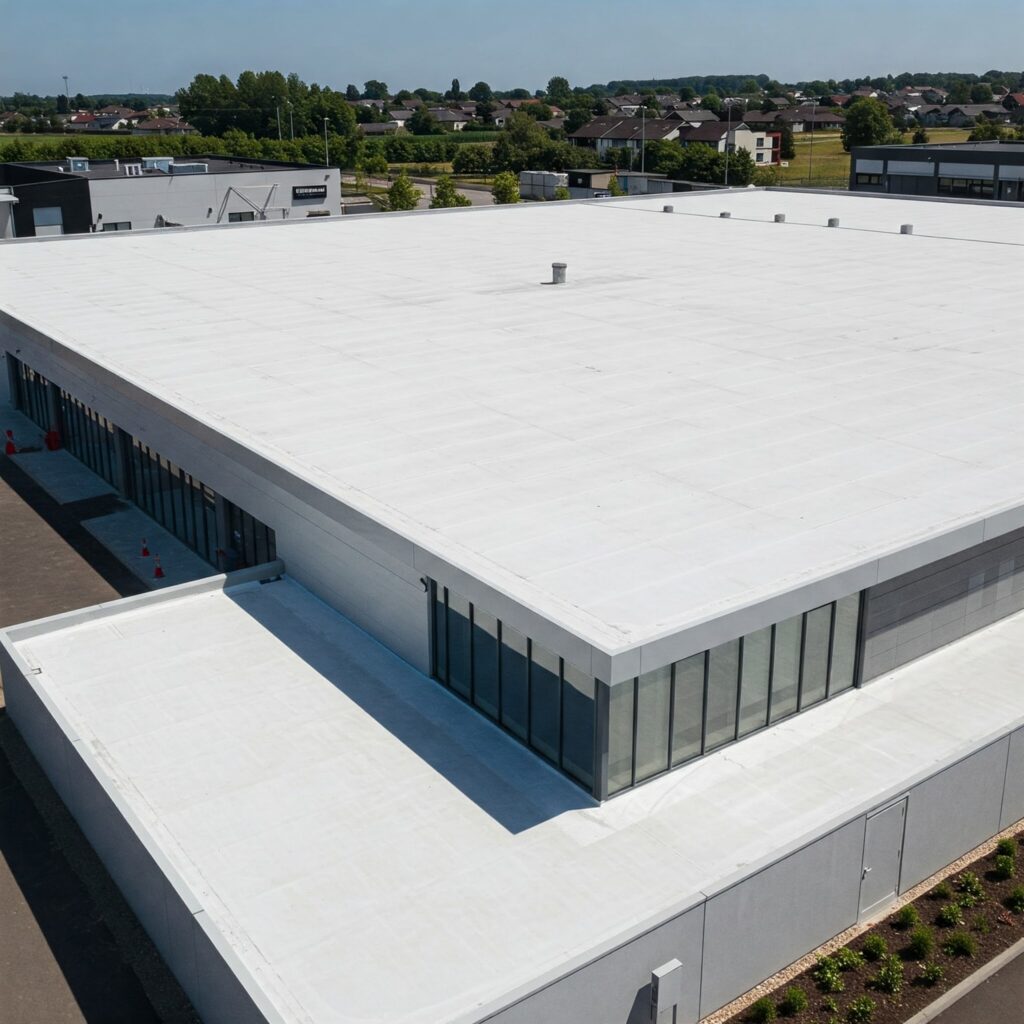
A standard TPO roof is white with a reflective surface that contributes to energy savings. Furthermore, white TPO roofing meets Cool Roof Rating Council (CRRC) requirements and has an initial reflectance value of 0.70 or greater. If you’re in a warmer climate or have a facility that bakes under the sun all day, TPO roofing may help reduce the cost of cooling.

Some manufacturers, like GAF, can also add custom colors like green or red to larger orders, but the reflective qualities will be lower.

Water Resistance

Because TPO roofing can also be used as an artificial pond liner, it’s highly water-resistant. Roofs with this material often have less problems with standing water.

Grease Resistance

For restaurants, a TPO roof is a decent choice over EPDM or asphalt systems, like mod-bit. Keep in mind that a proper grease containment system is needed to prevent premature aging due to excessive grease buildup for any kind of roof.

Aerial View Of A Commercial Building With A Bright White Tpo Single-Ply Flat Roof.

Cons of Commercial TPO Roofing

Punctures Easily

TPO has mild durability when it comes to punctures, putting it between EPDM and PVC in terms of toughness. Due to being single-ply, TPO is vulnerable to punctures. If you are worried about such damages, modified bitumen may be a better solution.

Material Consistency

During production, the thickness of TPO sheets is difficult to maintain, meaning that some sheets have a different temperature window than others. This may cause issues when heat-welding the TPO together. However, this was a bigger issue in the past, and most manufacturers have figured out how to create more consistent TPO sheets. Still, only ever choose TPO roofing from a brand you can trust.

Shorter Lifespan

Compared to other single-ply flat roof systems, TPO roofing has the shortest lifespan, ranging from 15-40 years. The lifespan depends greatly on two things: thickness and maintenance. The thinner the membrane, the quicker it wears out.

Roof Cleaning

Since the standard TPO color is white, the roof has to be cleaned every 2-3 years to remove any dirt buildup. Doing so helps you maintain the energy savings from the reflective surface. Once the surface gets dirty, the reflectivity declines.

Is TPO Roofing Right for Your Commercial Property?

Due to its durability and energy-efficiency, TPO is a commonly used material in the commercial industry. You can find thermoplastic olefin installed on a vast variety of buildings, including big box chains, fast food restaurants, warehouses, hospitals, schools, factories, hotels, and even municipal buildings.

Tip

If you're still unsure whether TPO roofing is right for your business, give RGB Construction a call at 856-264-9093. We'll walk you through the benefits and other available options to help you make the best choice.
Check out the following comparison between TPO and EPDM roofing to see which option is correct for your facility or property:

TPO vs. EPDM Roofing

Feature TPO Roofing EPDM Roofing
Material Type Single-ply thermoplastic membrane Single-ply synthetic rubber membrane
Typical Color Options Commonly white or light-colored for heat deflection Typically black; lighter colors available
Energy Efficiency Highly reflective and effective at reducing cooling costs Absorbs heat unless coated; performance varies by color
Durability Resistant to UV, punctures, and chemical exposure Flexible and long-lasting, especially in cold climates
Lifespan 20–30 years 25–35 years with regular maintenance
Installation Style Heat-welded seams that create strong connections Adhesive or taped seams depending on system
Weather Resistance Performs well in hot, sunny climates Performs well in cold or variable climates
Maintenance Needs Low maintenance; seam integrity should be monitored Low maintenance with proper installation
Best For Commercial buildings needing UV resistance and energy efficiency Facilities needing durability and flexibility in colder settings

Get Commercial TPO Roofing from South Jersey’s Commercial Roofers, RGB Construction

TPO roofing is ideal for South Jersey and its variable climate. Whether you’re located in Camden County along the waterfront or have an outlet near the shore, TPO roofing provides ample protection and energy-efficiency. If you’re looking for a cost-efficient material for your roof, consider TPO roofing. Learn more and receive a quote by contacting commercial roofers in your region.

We’re RGB Construction, and we’ve been serving South Jersey for over twenty years. Each member of our team has been vetted and certified by manufacturers like GAF. This allows us to provide you with extraordinary quality and comprehensive warranties. Whenever you need us for commercial roof repair, replacement, or maintenance, we’ll be there, ready to serve. Give us a call at 856-264-9093 or push the button below.

We provide TPO roofing for commercial properties in the following South Jersey counties:

Frequently Asked Questions About TPO Roofing

How long does TPO roofing last?
Most TPO systems last between 20–30 years depending on thickness, installation quality, and maintenance.

Is TPO roofing good for hot climates?
Yes. Because TPO is highly reflective, it helps reduce cooling costs and performs well under strong UV exposure.

Is TPO better than EPDM?
It depends on your goals. TPO is more reflective and energy-efficient, while EPDM performs well in colder climates and offers strong longevity.

Can TPO be installed over my existing roof?
Often, yes. Many buildings qualify for a TPO overlay, but only after an inspection determines the current roof’s condition.

Does TPO require much maintenance?
It requires low routine maintenance, though the white surface should be cleaned every few years to maintain energy efficiency.