
A composite roof — most commonly asphalt shingles — typically lasts between 20 and 30 years in New Jersey, depending on the shingle type, installation quality, attic ventilation, and ongoing maintenance.
While many manufacturers advertise 30-year, 50-year, or even lifetime warranties, those labels don’t always reflect how long a composite roof actually performs in New Jersey’s climate. Freeze-thaw cycles, humidity, storms, and heat all play a role in shortening real-world lifespan.
This guide explains what homeowners should realistically expect, how to tell if a composite roof is nearing the end of its life, and how to decide between repairs and replacement.
Key Takeaways for New Jersey Homeowners
-
Most composite roofs in NJ last 20–30 years, not the full warranty term
-
Architectural shingles last longer than basic 3-tab shingles
-
Installation quality and ventilation often matter more than brand
-
NJ weather accelerates wear through freeze-thaw cycles and storms
-
Roof inspections become critical after 15–20 years
What Is a Composite Roof?
A composite roof typically refers to asphalt-based shingles made from a fiberglass mat, asphalt coating, and protective mineral granules. These shingles are designed to balance affordability, durability, and ease of installation — which is why they are the most common roofing material on New Jersey homes.
There are several types of composite shingles, each with different performance expectations. If you want a broader breakdown of shingle performance, see our related guide:
👉 https://rgbconstructionservices.com/average-lifespan-shingle-roof/
Common Warranty Misconceptions
What Homeowners Misunderstand About Composite Roof Warranties
Many homeowners purchase composite shingles believing they’ve bought 30 or even 50 years of roof protection. The reality is more complex — and understanding the difference between what warranties promise and what they actually cover can save thousands in unexpected costs.
Misconception #1: “Lifetime Warranty” Means Your Roof Will Last a Lifetime
The Truth:
A “lifetime limited warranty” from manufacturers like GAF applies only while the original homeowner owns the property. If you sell your home, the warranty transfers at a reduced level to the new owner — typically lasting just 10-20 additional years as a non-transferable material warranty.
This is why a “lifetime” warranty is really a marketing term, not a guarantee of lifespan.
What it actually covers:
-
Manufacturing defects in the shingle material
-
Defects in the asphalt coating or fiberglass mat
-
Granule adhesion failure under normal conditions
What it does NOT cover:
-
Normal aging and weathering
-
Storm damage or impact
-
Installation errors
-
Poor attic ventilation
-
Lack of maintenance
Example: A 2015 roof with a “lifetime warranty” purchased today has already consumed 11 years of its non-prorated protection. After year 10, any warranty claim for material defects is reimbursed at a prorated percentage based on remaining lifespan — meaning you might receive only 50% of the material cost for a replacement, with zero labor coverage.

Misconception #2: The Warranty Covers Material AND Installation
The Truth:
Manufacturer warranties (GAF, Owens Corning, Tamko) cover material defects only. Installation quality is covered separately by your contractor’s workmanship warranty — and these are two completely different protections.
Manufacturer warranty covers:
-
Shingle manufacturing defects
-
Asphalt blistering or separation
-
Premature granule loss from material failure
-
Sealant strip adhesive failure
Contractor workmanship warranty covers:
-
Improper nailing patterns
-
Inadequate ventilation installation
-
Flashing installation errors
-
Improper overlap or alignment
-
Inadequate starter strip installation
Critical distinction: If your roof fails after 5 years due to poor installation (nails driven too high, inadequate ventilation, improper flashing), the manufacturer warranty will not help you. You’ll need to rely on your contractor’s workmanship warranty — which is why choosing a GAF Master Elite contractor matters.
RGB note: GAF Master Elite contractors are held to stricter installation standards and carry enhanced workmanship warranties (typically 10 years non-prorated, compared to standard 3-5 years for basic contractors). This protects your investment if installation errors occur.
Misconception #3: Warranty Claims Are Simple and Fast
The Truth:
Warranty claims require homeowner participation, documentation, and often inspection fees. Here’s what typically happens:
The process:
-
You schedule a professional roof inspection (cost: $150-$400, often your responsibility)
-
The inspector documents the issue and photographs damage
-
You file a claim with the manufacturer with inspection photos and proof of purchase
-
Manufacturer sends an adjuster to verify the defect matches their coverage criteria
-
If approved, they reimburse material cost only — you pay for labor and tear-off
-
After 10 years, reimbursement is prorated based on remaining lifespan
Common rejection reasons:
-
Lack of proper maintenance (debris in gutters, moss growth)
-
Poor attic ventilation (manufacturer’s inspection shows condensation damage)
-
Installation errors (nails in wrong location, improper flashing)
-
Storm damage (excluded from material warranty)
The real cost: A homeowner with a 15-year-old roof claiming granule loss might receive a 50% reimbursement on material cost ($1,500-$2,000) but still face $3,500-$5,000 in labor and tear-off costs — making the warranty claim financially insufficient.
Misconception #4: All Composite Roof Warranties Are the Same
The Truth:
Warranty terms vary significantly by shingle type and manufacturer. Here’s how they differ:
| Warranty Type | Coverage Period | What’s Covered | Cost to Homeowner | When It’s Useful |
|---|---|---|---|---|
| Standard Limited Warranty | 10 years non-prorated | Manufacturing defects only | Labor not included | First decade only |
| Prorated Warranty | 20–50 years (after year 10) | Partial material reimbursement | Costs increase over time | Limited value long-term |
| Master Elite Enhanced Warranty | 10 years non-prorated | Material + labor (installation defects) | Minimal (if certified) | Early installation issues |
| Algae / Stain Protection | 10–30 years | Algae & discoloration only | Labor not covered | Shaded & humid roofs |
Key takeaway: The warranty that matters most is the 10-year non-prorated period with your contractor’s workmanship warranty. After that, manufacturer coverage becomes increasingly expensive and limited in scope.
What Actually Voids Your Composite Roof Warranty
Manufacturers take warranty coverage seriously — and they have specific reasons to deny claims. Here are the most common warranty voids:
Installation-related voids:
-
Nails driven too high or too low on the shingle
-
Insufficient number of fasteners (less than 6 nails per shingle in high-wind areas)
-
Improper flashing installation (valleys, penetrations, edges)
-
Inadequate ventilation (less than 1 sq. ft. of ventilation per 150 sq. ft. of attic space)
Maintenance-related voids:
-
Debris accumulation causing water pooling
-
Clogged gutters leading to ice dams or water backup
-
Moss or algae growth that traps moisture
-
Lack of professional inspection every 2-3 years
-
Tree branches rubbing or damaging shingles
Environmental damage (excluded):
-
Hail or wind damage
-
Lightning strikes
-
Falling branches or objects
-
Improper roof load from snow/ice removal
-
Foot traffic or maintenance work by untrained individuals
Owner-caused issues:
-
Improper roof penetration (satellite dishes, vents, antennas installed incorrectly)
-
Pressure washing or harsh cleaning methods
-
Roof repairs by unqualified contractors
-
Modification of roof structure or ventilation system
The practical reality: The majority of warranty claim denials come from poor attic ventilation and lack of maintenance — not manufacturing defects. This is why RGB emphasizes these factors as critical to preserving warranty coverage and extending lifespan.
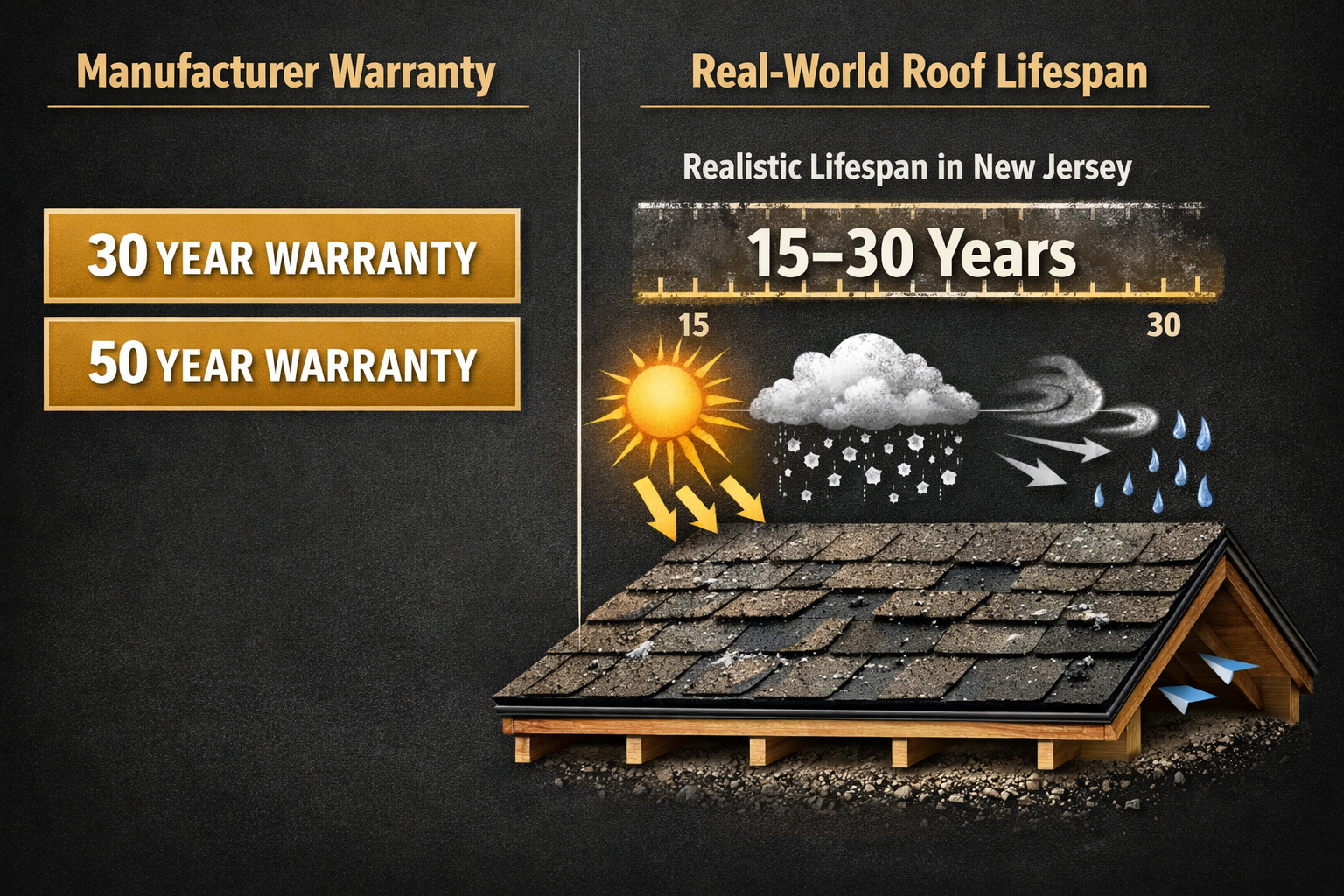
Manufacturer Warranties vs Real-World Lifespan
What Composite Roof Warranties Really Cover
Most composite roofing warranties:
-
Cover manufacturing defects, not normal aging
-
Are prorated after an initial period
-
Define “lifetime” as the time the original homeowner owns the house
Manufacturers like GAF explain warranty coverage in detail on their official documentation:
👉 https://www.gaf.com/en-us/for-homeowners/warranties
Why Warranties Don’t Equal Lifespan in New Jersey
In New Jersey, composite roofs are exposed to:
-
Rapid temperature swings
-
Moisture and humidity
-
Snow load and ice dams
-
High winds and storm events
These factors cause shingles to age faster than national averages, meaning real-world lifespan is often 5–10 years shorter than the warranty label suggests

Composite Roof Lifespan in New Jersey (By Type)
3-Tab Composite Shingles
3-tab shingles are thinner and more vulnerable to wind and winter stress. In New Jersey, they typically last 12–20 years.
Best for:
-
Budget-conscious homeowners
-
Short-term ownership plans
Architectural / Dimensional Composite Shingles
Architectural shingles are thicker, heavier, and more durable. They are the most popular composite option in New Jersey, with a realistic lifespan of 20–30 years when properly installed and ventilated.
For more detail on higher-grade shingle options, see:
👉 https://rgbconstructionservices.com/30-40-50-year-shingles-south-jersey/
Premium / “50-Year” Composite Shingles
Premium composite shingles often offer better aesthetics and impact resistance, but in New Jersey their lifespan usually still falls within the 20–30 year range unless ventilation and insulation are optimized.
They can be a good choice for appearance — but not necessarily for extending lifespan dramatically.
Composite Roof Lifespan in New Jersey
| Composite Roof Type | Manufacturer Warranty | Realistic NJ Lifespan | Common NJ Failure Causes | Best Fit for Homeowners |
|---|---|---|---|---|
| 3-Tab Composite Shingles | 20–30 years | 12–20 years | Wind blow-offs, ice dams, winter storms, poor ventilation | Short-term ownership, lowest upfront cost |
| Architectural / Dimensional Shingles | 30–50 years (limited lifetime) | 20–30 years | Freeze-thaw stress, wind gusts, heavy rain, moss growth | Most NJ homeowners seeking balance |
| Premium / Luxury Composite Shingles | 50 years to Lifetime | 25–35+ years | Heavy snow loads, coastal winds, repeated thermal cycling | 20+ year owners, resale-focused homes |
What Shortens the Life of a Composite Roof in NJ?
Several NJ-specific factors accelerate composite roof aging:
-
Freeze-thaw cycles that cause expansion and contraction
-
Poor attic ventilation that traps heat and moisture
-
Storm damage from wind, hail, and Nor’easters
-
Ice dams caused by clogged gutters or heat loss
-
Moss and algae growth from shaded roof areas
For a broader NJ climate overview, see:
👉 https://rgbconstructionservices.com/how-long-do-roofs-last-in-new-jersey/
Signs a Composite Roof Is Nearing the End of Its Life
Common warning signs include:
-
Curling or cupping shingles
-
Excessive granule loss in gutters
-
Bald or uneven shingle appearance
-
Repeated leaks or interior water stains
-
A roof age approaching or exceeding 20 years
If you notice several of these issues, replacement may be more cost-effective than repeated repairs.
Repair vs Replace: How to Decide
Repairs may make sense if:
-
Damage is isolated
-
The roof is under 15 years old
-
The overall system is still performing well
Replacement is often the smarter option if:
-
Damage is widespread
-
Repairs are frequent
-
The roof is 20+ years old
You may also want to review:
👉 https://rgbconstructionservices.com/3-signs-its-time-to-replace-your-roof/
How to Extend the Life of a Composite Roof
Homeowners can maximize lifespan by:
-
Scheduling professional inspections every 1–2 years
-
Keeping gutters clear to prevent ice dams
-
Ensuring proper attic ventilation
-
Addressing storm damage early
-
Using certified installers who follow manufacturer guidelines
How South Jersey Climate Accelerates Composite Roof Aging
Why Composite Roofs Age Faster in South Jersey Than National Averages
The warranty label on a GAF shingle says “30 years,” but South Jersey homeowners know their roofs often show serious wear by year 20. This isn’t a manufacturing failure — it’s climate reality.
South Jersey’s unique environmental conditions create accelerated aging that national roofing standards don’t fully account for. Understanding these factors helps homeowners make realistic investment decisions and prioritize maintenance.
Humidity: The Silent Degradation Factor
South Jersey averages 75-85% relative humidity, with summer months regularly exceeding 90% humidity. This is significantly higher than inland Mid-Atlantic regions (60-70% average) and creates three major problems for composite shingles:
1. Accelerated Asphalt Oxidation
Composite shingles rely on asphalt’s waterproofing properties. Humidity + heat accelerates the oxidation process that makes asphalt brittle:
-
Humidity increases moisture penetration into the asphalt layer, allowing water molecules to react with asphalt compounds
-
Higher temperatures amplify oxidation — summer temperatures in South Jersey reach 90°F+ regularly, while the shingle surface temperature can exceed 140°F in direct sun
-
Result: Shingles become brittle and prone to cracking by year 12-15, compared to year 18-20 in drier climates
What homeowners notice: Curling or cupping shingles, loss of flexibility, cracks when you walk on the roof.
2. Algae and Moss Growth
The combination of humidity, shade, and moisture creates ideal conditions for algae and moss:
-
South Jersey coastal areas (Cape May, Atlantic Counties) see algae growth within 3-5 years
-
Inland shaded areas (north-facing slopes, tree coverage) develop moss within 2-3 years
-
Growth mechanism: Algae and moss retain moisture against the shingle surface, preventing proper drying and accelerating granule loss
Why this matters: Algae doesn’t just look bad — it traps water that penetrates the granule layer and breaks down asphalt bonds. A roof with significant algae growth can lose lifespan equivalent to 5+ years of normal weathering.
GAF’s response: Their StainGuard Plus algae resistance is rated for 30 years, but in high-humidity South Jersey conditions, algae-resistant shingles still show early staining (cosmetic, not structural) by year 10-12.
3. Moisture Penetration into Decking
When humidity remains elevated, any cracked or separated shingle allows water vapor to penetrate:
-
Winter condensation risk: Poor attic ventilation + high ambient humidity = trapped moisture in attic space
-
Roof deck deterioration: Plywood decking begins rotting by year 10-15 if moisture isn’t properly vented
-
Hidden damage: Homeowners discover rot only when replacing the roof, adding $2,000-$4,000 to tear-off costs
Freeze-Thaw Cycles: Expansion and Contraction Stress
South Jersey experiences approximately 25-35 freeze-thaw cycles per winter, where temperatures cross the 32°F threshold repeatedly. Each cycle causes shingles to expand and contract, stressing sealant strips and shingle bonds.
How freeze-thaw works:
-
Temperature drops below 32°F: Water in shingle pores freezes, expanding slightly and pushing outward
-
Temperature rises above 32°F: Ice melts, water contracts, creating small gaps and stresses
-
Sealant degradation: The rubberized sealant strip (that holds shingles down) loses flexibility each cycle
-
Cumulative damage: After 25-35 cycles, sealant strips become brittle and fail
Real-world impact:
-
Year 5-7: First shingles begin lifting at edges (visible during roof inspections)
-
Year 8-12: Widespread sealant failure, allowing wind to catch lifted shingles
-
Year 12-15: Wind-blown shingles become common; leaks develop
Comparison to other climates:
-
Southern regions (20-30°F average winter minimum): 10-15 freeze-thaw cycles/year → slower aging
-
Midwest regions (below 0°F typical): Freeze-thaw ends by January → aging concentrated in early winter
-
South Jersey: 25-35 cycles spread across October-April → prolonged stress across entire winter season
Ice dam consequences:
Late-winter freeze-thaw cycles create ice dams when:
-
Warm attic air (from poor ventilation) melts snow at roof peak
-
Water flows down to the unheated eaves and freezes
-
Frozen water backs up under shingles
-
Ice dam persists for weeks, forcing water through shingle layers
Result: Interior water damage, interior mold growth, and compromised roof structure by late winter.
Temperature Swings: Thermal Cycling Stress
South Jersey’s mid-Atlantic location creates dramatic daily and seasonal temperature fluctuations that stress roofing materials.
Daily temperature swings:
A typical April or October day might see:
-
Morning: 45°F
-
Afternoon: 75°F
-
Evening: 50°F
-
Night: 35°F
Impact on shingles:
-
Asphalt expands in afternoon heat, contracts in evening cool
-
Sealant strips lose flexibility with each cycle
-
Metal flashing (around vents, chimneys) expands/contracts at different rates than shingles, creating gaps
Seasonal swings:
Winter-to-spring transition (January-April):
-
30-50°F temperature swings across 2-3 day periods
-
Most stressful season for shingle materials
-
Sealant strips experience maximum stress during this period
Summer-to-fall transition (August-October):
-
Rapid cooling causes contraction; roof deck materials shrink at different rates
-
Flashing gaps widen, creating water intrusion pathways
-
Granule-adhesion weakens from rapid cooling
Long-term consequence: Continuous thermal cycling reduces sealant effectiveness by 5-10 years compared to stable-climate regions. A 25-year architectural shingle in South Jersey effectively performs like a 15-20 year shingle in a stable climate.
Nor’easters and Storm Events
South Jersey’s Atlantic coast exposure creates elevated wind events that accelerate aging through direct damage and cumulative stress.
Annual wind event frequency:
-
Nor’easters: 2-4 per year (September-March), producing 45-70 mph gusts
-
Tropical systems: 1-2 per year (August-October), producing 40-60 mph gusts
-
Spring thunderstorms: 3-5 per year (April-June), producing 30-45 mph wind gusts
-
Winter nor’easters: 2-3 per year, producing 50-80 mph sustained winds with gusts to 100+ mph
Wind damage mechanisms:
-
Blow-offs: Weakened sealant strips + wind uplift pressure = shingles torn off
-
Accelerated sealant failure: Wind flexing weakens sealant bonds even without blow-offs
-
Granule loss: High-velocity wind dislodges granules, accelerating degradation
-
Flashing separation: Wind stress opens gaps in flashing, creating water entry points
Data point: Coastal South Jersey roofs (within 10 miles of Atlantic Ocean) experience 30-40% higher wind-related damage compared to inland roofs, according to insurance claim data.
Impact on warranty: Storm damage typically isn’t covered by manufacturer warranty. However, repeated wind events (2-3 per year) accelerate aging beyond normal weathering, reducing effective lifespan by 5-10 years in coastal areas.
Comparative Climate Impact: South Jersey vs. Regional Averages
Here’s how South Jersey’s climate compounds aging compared to surrounding regions:
| Climate Factor | South Jersey | Inland Mid-Atlantic | Impact on Roof Lifespan |
|---|---|---|---|
| Annual Humidity | 75–85% avg; 90%+ summer | 60–70% avg; 80% summer | +5–7 years accelerated aging |
| Freeze–Thaw Cycles | 25–35 per year | 15–20 per year | +3–5 years accelerated aging |
| Summer Shingle Temps | 140–160°F regularly | 130–145°F | Faster asphalt oxidation |
| Annual Nor’easters | 2–4 strong events | 1–2 strong events | Direct damage + cumulative stress |
| Winter Ice Dam Risk | High (ventilation issues common) | Moderate | Moisture intrusion risk |
| Coastal Salt Air | High (Atlantic counties) | None | Granule & coating erosion |
Summary: South Jersey’s combination of high humidity, freeze-thaw stress, temperature swings, and storm exposure creates a climate penalty of 5-10 years compared to stable inland regions.
Translation for homeowners: A 25-year architectural shingle in South Jersey performs comparably to a 15-20 year shingle in stable climates. Realistic planning should assume 20-25 year maximum lifespan rather than manufacturer-advertised timelines.
What Homeowners Can Do to Mitigate Climate Damage
While South Jersey’s climate cannot be changed, proper installation and maintenance can partially offset accelerated aging:
Critical attic ventilation:
-
Reduces internal moisture by 30-40%
-
Lowers attic temperatures by 15-20°F, reducing shingle surface stress
-
Prevents ice dams and condensation damage
-
Extends effective lifespan by 3-5 years
Professional inspections every 2 years:
-
Identifies early sealant failure before wind blow-offs occur
-
Catches algae/moss growth before moisture penetration
-
Detects flashing issues before interior water damage
-
Extends lifespan by catching problems early
Gutter cleaning and maintenance:
-
Prevents ice dam formation and water backup
-
Reduces moisture penetration into roof deck
-
Allows proper drainage of ice melt
Tree trimming and shading control:
-
Eliminates branch rubbing and puncture damage
-
Reduces moisture retention and algae/moss growth
-
Improves air circulation across roof surface
SECTION 3: Cost-Per-Year Comparison Table
The Real Cost of Roofing: Total Cost of Ownership Over Time
Homeowners often focus on the lowest upfront price for a new roof — but this overlooks a critical financial reality: a more expensive shingle with longer lifespan can actually cost less per year to own.
This analysis breaks down total cost of ownership for different composite shingle options in South Jersey, accounting for realistic lifespan, maintenance, and eventual replacement.
Total Cost-Per-Year Comparison (25-Year Planning Horizon)
| Shingle Type | Installed Cost | Realistic NJ Lifespan | Cost / Year (Material) | Maintenance / Year | Total Annual Cost | Best Fit Homeowner |
|---|---|---|---|---|---|---|
| 3-Tab Composite | $5.50–$7.00 / sq ft | 12–16 years | $275–$467 | $150–$200 | $425–$667 | Short-term owners, rentals |
| Architectural (Standard) | $7.50–$9.50 / sq ft | 20–25 years | $240–$380 | $200–$250 | $440–$630 | Most NJ homeowners |
| Architectural (Premium) | $9.00–$11.50 / sq ft | 22–28 years | $257–$414 | $200–$250 | $457–$664 | 15+ year ownership |
| Luxury Architectural | $10.50–$13.00 / sq ft | 24–30 years | $280–$433 | $250–$300 | $530–$733 | Premium homes, 25+ years |
Key Insights from Cost Analysis
1. Architectural Shingles Have Lower Per-Year Cost Than 3-Tab
Despite higher upfront costs, standard architectural shingles deliver:
-
12-20% lower annual material cost ($240-$380/year vs. $275-$467/year for 3-tab)
-
Longer lifespan (20-25 years vs. 12-16 years for 3-tab)
-
Better storm resistance (lower blow-off risk)
Real example: A homeowner comparing options for a 2,000 sq ft roof:
-
3-tab cost: $5,000 installed ÷ 14-year lifespan = $357/year
-
Architectural cost: $6,800 installed ÷ 22-year lifespan = $309/year
Savings: $48/year × 22 years = $1,056 saved over 22 years by choosing architectural shingles upfront.
2. Premium Architectural Shingles Show Diminishing Returns
Moving from standard to premium architectural shingles adds:
-
$1,500-$2,000 upfront cost for a 2,000 sq ft roof
-
2-3 additional years of lifespan
-
Similar per-year cost to standard architectural shingles
When premium makes financial sense:
-
Planned 25+ year ownership
-
High-wind coastal location (Cape May, Atlantic counties)
-
Aesthetic/resale value considerations for premium neighborhoods
-
Homeowner prioritizes maximum durability over cost optimization
When standard architectural makes sense:
-
Planned 15-20 year ownership
-
Inland South Jersey location
-
Balancing upfront cost with reasonable durability
-
Resale value adequately served by standard-grade appearance
3. Maintenance Costs Vary by Shingle Grade
Higher-grade shingles aren’t just more durable — they require similar (or sometimes lower) maintenance:
-
3-Tab: Higher algae growth risk, more frequent inspections needed ($150-$200/year)
-
Standard Architectural: Moderate algae resistance, standard inspection intervals ($200-$250/year)
-
Premium Architectural: Enhanced algae resistance, longer intervals between maintenance ($200-$250/year)
Counterintuitive finding: Premium shingles don’t dramatically reduce maintenance cost — but they reduce the urgency of maintenance. A small moss patch on a premium shingle at year 15 is less damaging than on a 3-tab at year 12, extending practical lifespan.
25-Year Total Cost Comparison (Detailed Example)
For a 2,000 sq ft roof, comparing total cost over 25 years with replacement in Year 13 and Year 25:
| Timeline | 3-Tab Scenario | Architectural Scenario |
|---|---|---|
| Year 0: Install | $5,000 | $6,800 |
| Years 1–12 Maintenance | $1,800 | $2,400 |
| Year 13 Replacement | $5,000 | — |
| Years 13–24 Maintenance | $1,650 | $2,400 |
| Year 25 Replacement | — | $6,800 |
| Total 25-Year Cost | $13,450 | $18,400 |
| Cost Per Year | $538 / year | $736 / year |
Wait — this shows 3-tab is cheaper? Yes, in a pure 25-year accounting. But this analysis misses critical factors:
The Complete Financial Picture: Beyond Simple Cost Per Year
The simple cost-per-year analysis above ignores factors that shift long-term value:
1. Interior Water Damage Costs (Hidden Risk)
If 3-tab shingles fail at year 12-14, you face:
-
Emergency replacement cost: $5,000-$6,000 (emergency pricing, not planned)
-
Potential water damage: $2,000-$15,000 (interior drywall, insulation, mold remediation)
-
Unexpected timing: Replacement happens before planned renovation/sale
With architectural shingles reaching year 20-25:
-
Planned replacement: Lower stress, better negotiating position
-
Water damage avoidance: Proper performance until end of lifespan
-
Sale timing advantage: Roof doesn’t fail during home listing/sale process
Real cost impact: Unplanned water damage claims add $2,000-$10,000 to the true cost of 3-tab roofs.
2. Sale Timing and Resale Value
A failing roof (age 14-16 years) during a home sale creates three problems:
-
Inspection contingency: Buyers demand $5,000-$8,000 price reduction or new roof
-
Financing obstacle: Lenders may require new roof before closing (adds $6,000-$8,000)
-
Negotiating weakness: Seller is forced to discount or replace
With architectural shingles at year 20-22:
-
Inspections pass without contingency: Roof is expected at this age
-
Less negotiating pressure: Roof is acceptable for remaining useful life
-
Buyer comfort: Newer roof = higher confidence in home condition
Real cost impact: Forced roof replacement or price reduction at sale time adds $5,000-$10,000 to effective cost of 3-tab roofs.
3. Quality-of-Life and Peace of Mind
3-tab roofs reaching year 12-14 require:
-
Frequent inspections to monitor deterioration
-
Anxiety about wind events (high blow-off risk)
-
Budgeting for unexpected replacement (financial stress)
With architectural shingles:
-
Confidence in performance through planned lifespan
-
Predictable replacement timing (no emergencies)
-
Lower stress about storms (better wind resistance)
Psychological cost: Annual stress and uncertainty has real value — estimated at $50-$150/year in homeowner peace of mind.
Revised Cost Analysis: Accounting for Hidden Costs
When accounting for water damage risk, sale timing, and financing contingencies:
| Cost Factor | 3-Tab Shingles (25 Years) | Architectural Shingles (25 Years) |
|---|---|---|
| Material + Installation | $10,000 (two roofs) | $13,600 (one roof) |
| Maintenance | $3,450 | $4,800 |
| Potential Water Damage (50% probability) | +$1,000 – $5,000 | +$0 – $1,000 |
| Sale Contingency / Price Reduction (Selling years 14–16) |
+$3,000 – $8,000 | $0 |
| Emergency Replacement Premium | +$1,000 – $2,000 | $0 |
| Total Realistic Cost (25 Years) | $18,450 – $29,450 | $18,400 – $19,400 |
| Cost Per Year | $738 – $1,178 / year | $736 – $776 / year |
Key finding: When realistic costs are included, architectural shingles are financially equivalent or superior to 3-tab, with far less risk.

Decision Framework: Which Shingle Type Is Right for You?
Use this framework to match shingle choice to your circumstances:
Choose 3-Tab if:
-
✓ Renting the property (minimize upfront investment)
-
✓ Planning to sell within 10 years
-
✓ Extremely budget-constrained
-
✓ Roof is secondary to other home improvements
-
⚠️ Accept: Higher risk of emergency replacement, water damage
Choose Standard Architectural if:
-
✓ Planning to stay 15+ years
-
✓ Inland South Jersey location (moderate climate stress)
-
✓ Balancing upfront cost with durability
-
✓ Seeking lowest long-term cost per year
-
✓ Want reliable performance without premium pricing
Choose Premium Architectural if:
-
✓ Planning to stay 25+ years
-
✓ Coastal location (Cape May, Atlantic counties) with high wind exposure
-
✓ Aesthetic quality is important for resale value
-
✓ Maximum durability and peace of mind are priorities
-
✓ Can justify 10-15% premium for 2-3 additional years of lifespan
Choose Luxury/High-End Architectural if:
-
✓ Premium appearance is significant (resale/curb appeal)
-
✓ Maximum wind resistance is critical (coastal/exposed location)
-
✓ Long-term ownership (25+ years planned)
-
✓ Budgeting is not primary constraint
-
⚠️ Note: Per-year cost is similar to standard architectural — premium mainly for aesthetics
RGB’s Professional Recommendation
For most South Jersey homeowners planning to stay 15+ years, standard architectural shingles offer the optimal balance of cost, durability, and performance.
This choice:
-
Delivers lower annual cost than 3-tab shingles
-
Provides reliable 20-25 year performance in South Jersey climate
-
Avoids unplanned emergencies and water damage risks
-
Simplifies financial planning with predictable replacement timing
Premium grades are worthwhile only if aesthetic upgrade or coastal wind resistance are explicit priorities — not for financial reasons alone.
Final Thoughts for New Jersey Homeowners
Composite roofs remain a reliable and cost-effective option for New Jersey homes — but understanding realistic lifespan expectations helps homeowners plan smarter and avoid surprises.
If your composite roof is approaching 15–20 years old, a professional inspection can provide clarity on whether repairs will extend its life or if replacement is the better long-term investment.
At RGB Construction, EXCELLENCE is not just the goal – IT’S THE STANDARD!